Ruellia exostemma

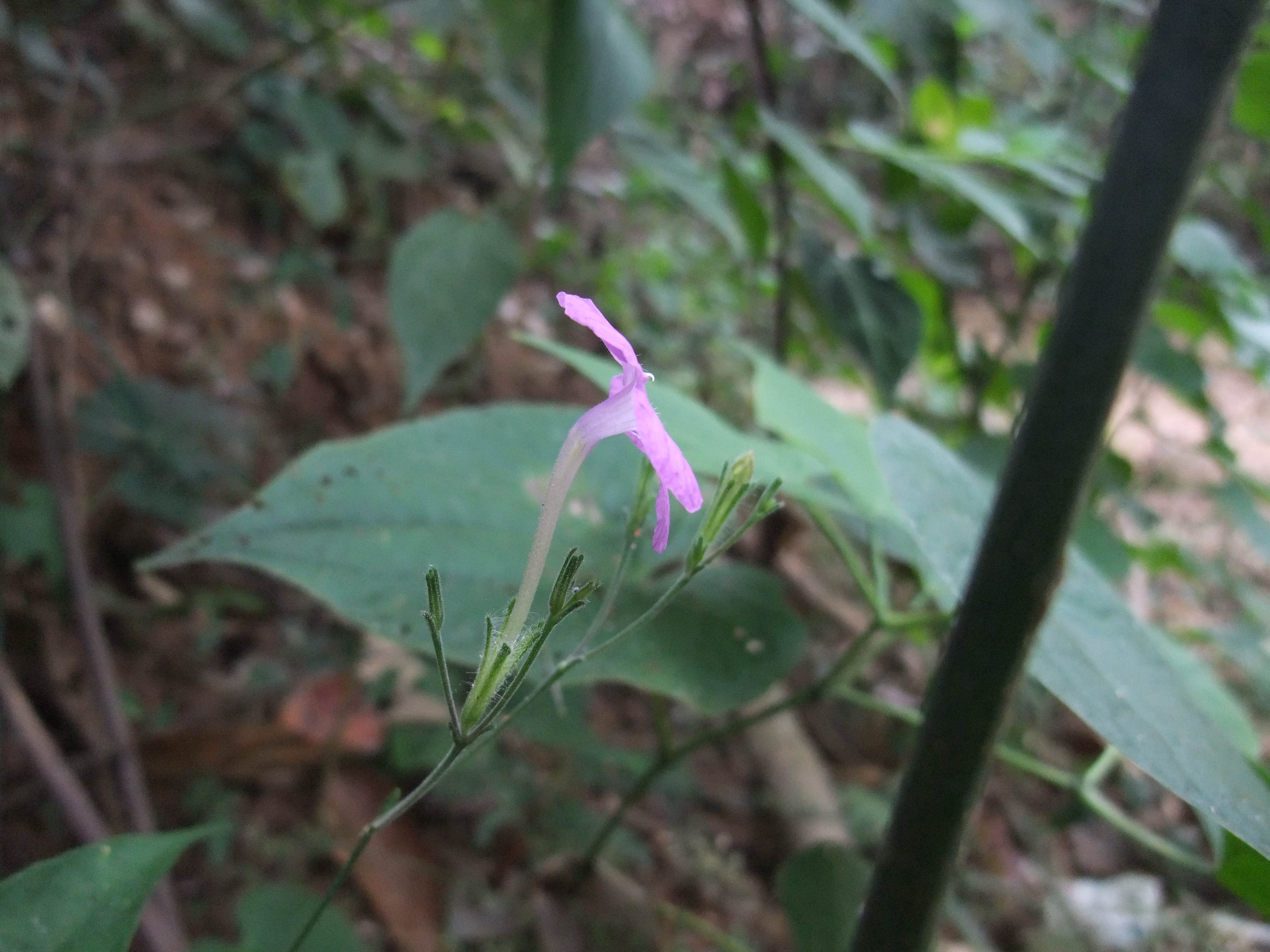
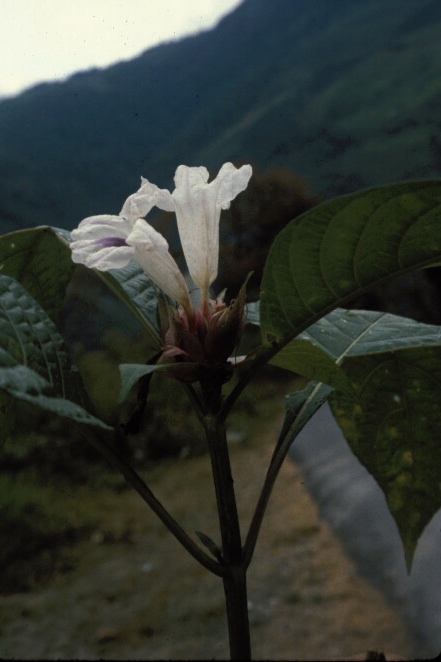
Ruellia exostemma is (was?) an erect shrub endemic to Venezuela, known from 18 total collections primarily in the state of Yaracuy. It grows (grew?) in cloud forests between 1200–1800 m elevation. Like many other Ruellias found at this elevation, Ruellia exostemma is adapted to bat pollination and its large, yellow, gibbous, nocturnal corollas will convince you of such.

The 18 documented collections represent 10 populations (Tripp & Luján 2017). Of these, half were made prior to 1980. Of the remaining half, most derive from areas that are within or near current logging concessions. In 2009, my colleague and dear friend Manuel Luján and I searched for populations of this species in the vicinity of El Amparo and Candelaria, Yaracuy. This area held one of the most recent and extensive populations of Ruellia exostemma as documented in herbaria: labels noted that plants occurred in ‘virgin cloud forest’. We visited the site in 2009 and found the area to be completely leveled – deforested and devastated beyond any foreseeable means of ecological recovery. A bona fide dustbowl, in fact. Not a sliver of anything green, anywhere in sight. And for this, for everything, our species is truly out of tune.

In our monograph of Venezuelan Ruellia (Tripp & Luján 2017), we considered all ‘modern’ (post 1980) populations to be at high risk of extirpation and assessed the species as Endangered under IUCN (2014) criteria EN B1a,b(iii) and B2a,b(iii). The reality is that I do not think I will ever have the privilege of seeing this one alive. In the business of biodiversity, you win some and lose some. In the 21st C, it feels like more losing than winning.

“As freezing persons recollect the snow, first chill, then stupor, the letting go.”

Botanical illustration by Amanda Krevitz (coming soon), Academy of Natural Sciences of Philadelphia (PH Herbarium)

Ruellia macrophylla

OK, forgive the quality of the photograph of what is admittedly one of the most common species in the genus (trust there is a back story associated with this, and move on….), but here it is: Ruellia macrophylla. One of the most easy to recognize species in the Neotropics because…. I said so? Look for the long pedunculate inflorescences that boast big, gaudy, and floppy red flowers. You will find this species clambering against steep slopes that line the highways in northern Colombia and Venezuela. Its leaves aren’t exceptionally large, as implied by the specific epithet, but if you need further confirmation, keep it company until it sets seed, then look for hygroscopic margins restricted to the margins of said seeds. Or just ask a taxonomist.

Ruellia macrophylla is widespread in northern South America, very much unlike its nearest relative, Ruellia lutea (aka, Ruellia macrophylla var. lutea until Manuel and I raised this taxon to the rank of species in our monograph of Venezuelan Ruellia). In contrast, Ruellia lutea grows only in the narrowest stretch of northern Venezuela where it occurs sympatrically with, and flowers contemporaneously with, Ruellia macrophylla. Because no hybrids between the two have ever been seen and thus these two entities appear to be reproductively isolated, I feel quite comfortable with the decision to recognize them as separate species.

Anyway, I digress. Take a trip to Parque Nacional Henri Pittier (Venezuela) or Parque Nacional Tayrona (Colombia) and marvel at a few million years of evolutionary history that ‘built’ Ruellia macrophylla. Natural selection, we love you.

Wild Collected, Colombia, Tripp & Luján #490 (RSA) and Tripp et al. #5174 (COLO); Photos by E. Tripp & N. Medina

Ruellia longifilamentosa

OOOH LAAH! A Heartthrob Eastern Time! I have been dreaming wistfully of this species for years. I was sure it was extinct. I was sure nobody in the world would ever see it again in the cellulose, including me. I was wrong. Known from < 5 total collections throughout history, it is with great happiness and relief to report that Ruellia longifilamentosa is in fact extant in the wild as of January 2015. Its rarity is presumably in part related to its habitat requirements: high quality, intact, wet, native forest at mid elevations, which are increasingly threatened (or already demolished) throughout the Neotropics. This habitat need applies to most other bat-pollinated (or please at least allow me to say: bat-adapted) Ruellia. As such, protecting these mid-montane mesic ecosystems will be vital to long-term preservation of an entire pollination syndrome of plants in this lineage. This population was collected in Cundinamarca, near Finca La Concepcíon along the banks of the Río Guane. The length of the exserted stamens (that surpasses the total length of the corolla) is enough to make you, too, dream wistfully.

Ruellia longifilamentosa is a small tree to 3m. Bat pollination in Ruellia seems to be correlated with this treelet growth form (as well as production of flowers in long, terminal panicles). It is in fact the case based on a formal analysis that I conducted waaaaaaay back in graduate school, but never published. Oh well – so much to do, so little time. In any event, this correlate must have something to do with getting ones flowers up off the ground and in a more aerial position for bat visitation. Says me. Ruellia longifilamentosa is sister to R. humboldtiana (red, bird), both of which are part of the Ruellia tubiflora (white, big bee) clade. That’s a lot of floral diversity over a small phylogenetic distance, if that’s the sort of thing that turns you on….

Wild collected, Colombia, Godden et al. #268 (COLO) and Tripp et al. #5262 (COLO); Photo by Grant Godden

Ruellia macarenensis

What happens when we let special places remain special places, without intervening, disrupting, leveling, developing, or otherwise disturbing such special habitats? Here is what I know about Ruellia macarenensis. Prior to our visit to Colombia in January 2015, this enigmatic, highly restricted-endemic species was known only from its type collection, which was made in dense forests along the banks of the Río Güejar near the confluence with Río Zanza at the northern edge of the Cordillera Macarena. It was flowering in August of 1950. The Serranía de la Macarena is a biodiversity-rich isolated massif that lies due east of the Cordillera Oriental of Colombia. It represents a unique ecological transition zone between Amazonian, Orinoco, and Andean biotas.

Fast forward 65 years and our field team revisited the type locality to find, all these years later, the population to still be extant, albeit in fruit only in January. If it weren’t for the flowering material available on the holotype and its duplicates, I would swear that Ruellia macarenensis was conspecific with Ruellia jussieuoides. But the type (and protologue) clearly indicate a very different floral morphology of R. macarenensis compared to R. jussieuoides, thus readily distinguishing the two morphologically as different species. I do however predict close relationship between them – both share a conspicuous presentation of primary and secondary veins raised far about the leaf blade surface. Whereas Ruellia macarenensis is highly restricted and endemic to this one small corner of Earth, Ruellia jussieuoides occupies a much broader range that includes large portions of the Amazon north to mesic southern Mexico. Sounds like a classic case of peripatric speciation to me.

Wild collected, Colombia, Godden et al. #254 (COLO) and Tripp et al. #5248 (COLO); Photo by Grant Godden

Ruellia yurimaguensis

Behold, a purple-flowered herb from wet forests of tropical western South America. I have never seen or collected it, but I have some suspicions that it may be synonymous with a couple of other ‘species’ in that part of the world. Many thanks to Alexander for sharing his photograph collection with me.

Wild collected, Bolivia, Erin Tripp #6031 w/ Manuel Luján, and Dina Clark; Photos by Manuel Luján and Dina Clark

Ruellia wurdackii

Ruellia_wurdackii

Here is a highly enigmatic species from Venezuela. I have tried to find it in the field, but have failed. If you know something of this plant, please do share. Its calyces remind me of Ruellia glischrocalyx, from Brazil.

Collector and collection information unknown, Venezuela; Photo unknown. If it is yours, kindly claim!

Ruellia tubiflora

Ruellia_tubiflora

Oh, to rewind time and ask Emery Leonard out to dinner. Then, I might understand his basis for his habitual naming of minor variants. I might also ask him about the origins of his awesome first name. In any case, I digress. Ruellia tubiflora (var. tubiflora, if I must) is a small tree that produces lovely white flowers with a purple splotch in the throat. It was described a very long time ago by Kunth (1818) and grows happily in lowland to mid montane forests of northern South America – primarily Colombia. Some number of years later, a variant that produces pure white flowers was discovered and named by Leonard as Ruellia tubiflora var. tetrastichantha (a mouthful). This variety grows abundantly in similar habitats and in southern Centeral American and northern South America – primarily Venezuela. Along with variety tetrastichantha, Leonard proceeded to names six other infraspecific taxa… most of which are not in current use.

Here is a photo that long predates my existence in botany. It’s actually the first picture of any Ruellia that I ever laid eyes on…. pretty enough to convince me that the genus warranted further thought. Ruellia tubiflora is a highly charismatic species that is member to a clade that leaves behind conspicuous, congested, cone-like scars after flowers (and their pedicels) that have fallen. See Tripp 2007, Systematic Botany. Plants in this clade tend to prefer high quality, tropical habitats that stay on the wet side throughout the year. Thanks to Lucinda for sharing this with me as a young intern, way way back in 2002. I have since seen and photographed this beautiful plant numerous times in the wild, but I still prefer the above photo, which so altered the course of my life.

Wild collected, Colombia, McDade & Stein #933 (DUKE); Photo by Lucinda McDade

Ruellia tuberosa

Many people have expressed frustration at this species to me… that it looks a lot like a few other weedy, pedunculate, purple-flowered species (e.g., R. simplex, R. nudiflora). I find Ruellia tuberosa, the type species of the genus, to be rather distinctive owing to its leaves that are almost always obovate or oblanceolate. Its native range is northern South America.

The second photo depicts a fruiting specimen…long elliptical in shape, preparing to explode (yes, ballistically) and fling its seeds about the environment.

Wild collected, Venezuela, Tripp & Lujan (RSA-POM); Photos by Erin Tripp

Ruellia tolimensis

One quick look at this plant would send most to the name Ruellia potamophila. But you would be wrong if you did that. Look closer. Note the very gradual expansion of the narrow, unexpanded portion of the tube in this plant compared to the very abrupt expansion of the narrow, unexpanded portion tube to the expanded portion of the tube in Ruellia potamophila. Now do you see the difference? To say that beauty is in the details drastically underestimates the enormity of the task of taxonomists. Every detail counts. This is Ruellia tolimensis. Until now, known only from a single collection to my knowledge (that of the type). Note the slight curved nature of the tube in R. tolimensis. Even Leonard nailed that one in the protologue….

Ruellia tolimensis is an incredibly rare and undercollected species that is, so far as known, endemic to Colombia. I haven’t had the pleasure yet of introducing it to the sequencer, but when I do, I will be able to confirm its placement in the Physiruellia clade based on its seeds with trichomes restricted to the margins. I wasn’t able to lay eyes on the plant personally because I had to leave Colombia after one month in the field. Nico, Grant, and Manuel continued on without me, and they found this species just a few short days after my departure….

Wild collected, Colombia, Medina et al. #849 [COLO]; Photo by N. Medina