Ruellia macrophylla

OK, forgive the quality of the photograph of what is admittedly one of the most common species in the genus (trust there is a back story associated with this, and move on….), but here it is: Ruellia macrophylla. One of the most easy to recognize species in the Neotropics because…. I said so? Look for the long pedunculate inflorescences that boast big, gaudy, and floppy red flowers. You will find this species clambering against steep slopes that line the highways in northern Colombia and Venezuela. Its leaves aren’t exceptionally large, as implied by the specific epithet, but if you need further confirmation, keep it company until it sets seed, then look for hygroscopic margins restricted to the margins of said seeds. Or just ask a taxonomist.

Ruellia macrophylla is widespread in northern South America, very much unlike its nearest relative, Ruellia lutea (aka, Ruellia macrophylla var. lutea until Manuel and I raised this taxon to the rank of species in our monograph of Venezuelan Ruellia). In contrast, Ruellia lutea grows only in the narrowest stretch of northern Venezuela where it occurs sympatrically with, and flowers contemporaneously with, Ruellia macrophylla. Because no hybrids between the two have ever been seen and thus these two entities appear to be reproductively isolated, I feel quite comfortable with the decision to recognize them as separate species.

Anyway, I digress. Take a trip to Parque Nacional Henri Pittier (Venezuela) or Parque Nacional Tayrona (Colombia) and marvel at a few million years of evolutionary history that ‘built’ Ruellia macrophylla. Natural selection, we love you.

Wild Collected, Colombia, Tripp & Luján #490 (RSA) and Tripp et al. #5174 (COLO); Photos by E. Tripp & N. Medina

Ruellia speciosa


This slideshow requires JavaScript.


RUELLIA SPECIOSA

Ruellia speciosa is, true to its epithet, a beautiful species. And one of my favorites. I could probably write a short story about this one if commissioned (one can dream)… about watching for hours the hummingbirds fawn over it in a deep fissure on top of a mountain overlooking Ciudad Oaxaca…. about its wonderfully pungent odor…about the population mutants that produce the strangest internal floral accessory structures. Well, best just to read all about it in the (non-commissioned) taxonomic revision of Ruellia section Chiropterophila (Tripp 2010, Systematic Botany). I first (and only) saw this species alive, in the field, in the year 2005.

I owe a great deal of gratitude to Salvador Acosta for leading me to this population, which represents the only I’ve seen of this species alive in the field. I have searched and searched for many other populations, based on localities from historical herbarium records, but all such attempts were unsuccessful. It’s true and sad: Ruellia speciosa is a species that is far less common than it used to be….

Update as of January 2016: I returned to the above locality some 10 years after I first visited it. The population has now been extirpated from housing development. Not all stories have a happy ending.

Wild collected, Mexico, Tripp & Acosta 175 (DUKE); Photo by Erin Tripp.

Ruellia longifilamentosa

OOOH LAAH! A Heartthrob Eastern Time! I have been dreaming wistfully of this species for years. I was sure it was extinct. I was sure nobody in the world would ever see it again in the cellulose, including me. I was wrong. Known from < 5 total collections throughout history, it is with great happiness and relief to report that Ruellia longifilamentosa is in fact extant in the wild as of January 2015. Its rarity is presumably in part related to its habitat requirements: high quality, intact, wet, native forest at mid elevations, which are increasingly threatened (or already demolished) throughout the Neotropics. This habitat need applies to most other bat-pollinated (or please at least allow me to say: bat-adapted) Ruellia. As such, protecting these mid-montane mesic ecosystems will be vital to long-term preservation of an entire pollination syndrome of plants in this lineage. This population was collected in Cundinamarca, near Finca La Concepcíon along the banks of the Río Guane. The length of the exserted stamens (that surpasses the total length of the corolla) is enough to make you, too, dream wistfully.

Ruellia longifilamentosa is a small tree to 3m. Bat pollination in Ruellia seems to be correlated with this treelet growth form (as well as production of flowers in long, terminal panicles). It is in fact the case based on a formal analysis that I conducted waaaaaaay back in graduate school, but never published. Oh well – so much to do, so little time. In any event, this correlate must have something to do with getting ones flowers up off the ground and in a more aerial position for bat visitation. Says me. Ruellia longifilamentosa is sister to R. humboldtiana (red, bird), both of which are part of the Ruellia tubiflora (white, big bee) clade. That’s a lot of floral diversity over a small phylogenetic distance, if that’s the sort of thing that turns you on….

Wild collected, Colombia, Godden et al. #268 (COLO) and Tripp et al. #5262 (COLO); Photo by Grant Godden

Ruellia macarenensis

What happens when we let special places remain special places, without intervening, disrupting, leveling, developing, or otherwise disturbing such special habitats? Here is what I know about Ruellia macarenensis. Prior to our visit to Colombia in January 2015, this enigmatic, highly restricted-endemic species was known only from its type collection, which was made in dense forests along the banks of the Río Güejar near the confluence with Río Zanza at the northern edge of the Cordillera Macarena. It was flowering in August of 1950. The Serranía de la Macarena is a biodiversity-rich isolated massif that lies due east of the Cordillera Oriental of Colombia. It represents a unique ecological transition zone between Amazonian, Orinoco, and Andean biotas.

Fast forward 65 years and our field team revisited the type locality to find, all these years later, the population to still be extant, albeit in fruit only in January. If it weren’t for the flowering material available on the holotype and its duplicates, I would swear that Ruellia macarenensis was conspecific with Ruellia jussieuoides. But the type (and protologue) clearly indicate a very different floral morphology of R. macarenensis compared to R. jussieuoides, thus readily distinguishing the two morphologically as different species. I do however predict close relationship between them – both share a conspicuous presentation of primary and secondary veins raised far about the leaf blade surface. Whereas Ruellia macarenensis is highly restricted and endemic to this one small corner of Earth, Ruellia jussieuoides occupies a much broader range that includes large portions of the Amazon north to mesic southern Mexico. Sounds like a classic case of peripatric speciation to me.

Wild collected, Colombia, Godden et al. #254 (COLO) and Tripp et al. #5248 (COLO); Photo by Grant Godden

Yongbin Zhuang

Yongbin Zhuang

Yongbin is a postdoc and started working with Erin in the fall of 2015. He is from Shan Dong, China and got his PhD in Molecular Biology from the South Dakota State University in 2014. His graduate study focused mainly on the utilization of Next Generation Sequencing to uncover genes involved in plant-microbe interactions. He moved to Denver, Colorado in 2015 to escape the harsh weather in South Dakota. Over the years he has further developed his interests in bioinformatics, data mining, and programming. As a postdoc, he is working on evolution of the anthocyanin pathway in Ruellia, in attempt to unveil constraints on floral color evolution. In his free time, he enjoys traveling and cooking.

His CV is available here.

Mandy Malone

Mandy

Mandy, a resident of Colorado since 2008, is an undergraduate at CU Boulder majoring in Ecology and Evolutionary Biology. Her research this year involves creating a checklist for Marchantiophyta in the Comanche National Grasslands of Southeast Colorado. Marchantiophyta, or liverworts, are of interest because they are silly and ridiculous in name and form, which are two qualities that Mandy appreciates in a plant. In addition to this, liverworts are a fascinating group that descends from the common ancestor of all land plants. This has interesting evolutionary implications given how static the liverwort’s morphological form has remained. The region of study was selected because previous undergraduate researcher, Joseph Kleinkopf, found molecularly distinctly populations of Amorpha nana in the grasslands, indicating that this might be a region of neoendemism. In her free time Mandy enjoys climbing things and meandering around Boulder.

Publications

Books
2. Tripp, E.A. In Press. Field Guide to the Lichens of White Rocks Open Space. University Press of
Colorado, Boulder, Colorado.
1. Lendemer, J.C., R.C. Harris, and E.A. Tripp. 2013. Lichens and Lichenicolous Fungi of Great Smoky
Mountains National Park. Memoirs of the New York Botanical Garden, New York
Botanical Garden Press: Bronx, New York, 260 p.
Peer-Reviewed Articles
38. Tripp, E.A. and J.C. Lendemer. In Press. Candelariella clarkiae and Lecidea hoganii: two lichen
species new to science from White Rocks Open Space, City of Boulder, Colorado. The
Bryologist.
37. Tripp, E.A. In Press. Lichen inventory of White Rocks Open Space (Boulder, Colorado).
Western North American Naturalist.
Erin A. T ripp ~ 4
36. Rabinowitz, O.* and E.A. Tripp. In Press. Observations on the phelloderm of aspens (Populus
tremuloides). Western North American Naturalist.
35. Tripp, E.A. and D.M. Koenemann**. In Press. Nomenclatural synopsis of the genus Sanchezia
(Acanthaceae). Novon.
34. Lendemer, J.C. and E.A. Tripp. 2015. Lecanora anakeestiicola (Lecanorales): an unusual new
fruticose species from Great Smoky Mountains National Park in eastern North
America. The Bryologist 118 1-10.
33. Tripp, E.A. and J.C. Lendemer. 2014. Sleepless nights: when you cannot find anything to use in
describing new taxa but molecules. TAXON 63: 969-971.
32. Tripp, E.A. and M. Fekadu**. 2014. Comparative leaf and stem anatomy in selected species of
Ruellieae (Acanthaceae) representative of all major lineages. Kew Bulletin 69: 9543 (8
pgs).
31. Lendemer, J.C., E.A. Tripp, and J. Sheard. 2014. Review of Rinodina Ach. in the Great Smoky
Mountains highlights the significance of this “island of biodiversity” in North America.
The Bryologist 117: 259-281.
30. Lendemer, J.C. and E.A. Tripp. 2014. Discovery of Gyalideopsis mexicana in the United States.
North American Fungi 7: 1-4.
29. Tripp, E.A. and L.A. McDade. 2014. A rich fossil record yields calibrated phylogeny for
Acanthaceae (Lamiales) and evidence for marked biases in timing and directionality of
intercontinental disjunctions. Systematic Biology 63: 660-684.
28. Freyre, R. and E.A. Tripp 2014. Artificial hybridization between the U.S.A. native Ruellia
caroliniensis and the invasive Ruellia simplex (syn. R. brittoniana). HortScience 49: 991-
996.
27. Tripp, E.A. and L.A. McDade. 2014. Time-calibrated phylogenies of hummingbirds and
hummingbird-pollinated plants reject hypothesis of diffuse co-evolution. Aliso 31: 89-
103.
26. Callmander, M.W., E.A. Tripp, and P.B. Phillipson. 2014. A new name in Ruellia L. (Acanthaceae)
for Madagascar. Candollea 69: 81-83.
25. Harris, R.C., E.A. Tripp, and J.C. Lendemer. 2014. Arthopyrenia betulicola (Arthopyreniaceae,
Dothidiomycetes), an unusual new lichenized fungus from high elevations of the
southern Appalachian mountains. Aliso 31: 77-81.
24. Tripp, E.A. and K.E. Hoagland. 2013. Typifying an era in biology through synthesis of
biodiversity information. Taxon 62: 899-911.
23. Tripp, E.A. S. Fatimah*, I. Darbyshire, and L.A. McDade. 2013. Origin of African Physacanthus
(Acanthaceae) Via Wide Hybridization. PLoS ONE 8: e55677.
22. Tripp, E.A., T.F. Daniel, S. Fatimah*, and L.A. McDade. 2013. Phylogenetic relationships within
Ruellieae (Acanthaceae), and a revised classification. International Journal of Plant Sciences
174: 97-137.
21. Darbyshire, I., Tripp, E.A. and K.G. Dexter. 2012. A new species and a revised record in the
Namibian Barleria (Acanthaceae). Kew Bulletin 67: 759-766. (including an erratum,
published in early 2013).
20. Tripp, E.A. and K.G. Dexter. 2012. Taxonomic novelties in Namibian Ruellia (Acanthaceae).
Systematic Botany 37: 1023-1030.
19. Tripp, E.A. and L.A. McDade. 2012. New synonymies for Ruellia (Acanthaceae) of Costa Rica
and notes on other neotropical species. Brittonia 64: 305-317.
18. Tripp, E.A. and J.C. Lendemer. 2012. (3-4) Request for binding decisions on the descriptive
statements associated with Mortierella sigyensis (fungi: Mortierellaceae) and Piromyces
cryptodigmaticus (fungi: Neocallimastigaceae). Taxon 61:886-888.
Erin A. T ripp ~ 5
17. Tripp, E.A. and S. Fatimah*. 2012. Comparative anatomy, morphology, and molecular
phylogenetics of the African genus Satanocrater (Acanthaceae). American Journal of
Botany 99: 967-982.
16. Tripp, E.A. and J.C. Lendemer. 2012. Not too late for American biodiversity? New discoveries
give hope for mitigation of an extinction epidemic and call for increased inventory and
protection of biodiversity in our backyards. BioScience 62: 218-219.
15. Tripp, E.A. 2010. Taxonomic revision of Ruellia sect. Chiropterophila (Acanthaceae): a lineage of
rare and endemic species from Mexico. Systematic Botany 35: 629-661.
14. Tripp, E.A. and J.C. Lendemer. 2010. The genus Platygramme in North America. Castanea
75:388-393.
13. Tripp, E.A., J.C. Lendemer, and R.C. Harris. 2010. Resolving the genus Graphina Müll. Arg. in
North America: new species, new combinations, and treatments for Acanthothecis,
Carbacanthographis, and Diorgyma. The Lichenologist 42: 55-71.
12. Tripp, E.A., T.F. Daniel, J.C. Lendemer, and L.A. McDade. 2009. New molecular and
morphological insights prompt transfer of Blechum to Ruellia (Acanthaceae). Taxon 58:
893-906.
11. Schmidt-Lebuhn, A. and E.A. Tripp. 2009. Ruellia saccata (Acanthaceae), a new species from
Bolivia. Novon 19:515-519.
10. Stone, D.E., S.H. Oh, E.A. Tripp, L.E. Ríos, and P.S. Manos. 2009. Natural history, distribution,
phylogenetic relationships, and conservation of Central American black walnuts
(Juglans sect. Rhysocaryon). Journal of the Torrey Botanical Society 136: 1-25.
9. Tripp, E.A. and P.S. Manos. 2008. Is floral specialization an evolutionary dead-end? Pollination
system evolution in Ruellia (Acanthaceae). Evolution 62: 1712-1737.
8. Tripp, E.A. 2007. Evolutionary relationships within the species-rich genus Ruellia (Acanthaceae).
Systematic Botany 32: 628-649.
7. McDade, L.A. and E.A. Tripp. 2007. Synopsis of Costa Rican Ruellia L. (Acanthaceae), with
descriptions of four new species. Brittonia 59: 199-216.
6. Lendemer, J.C., R.C. Harris, and E.A. Tripp. 2007. Heterodermia neglecta, a new lichen species
from eastern North America. Bryologist 110: 490-493.
5. McDade, L.A. and E.A. Tripp, with assistance from T.F. Daniel. 2007. Acanthaceae of La Selva
Biological Station, Costa Rica. In: La Flora Digital de La Selva. pdf available at
http://clade.acnatsci.org/mcdade/
4. Tripp, E.A. and K.G. Dexter. 2006. Sabal minor (Arecaceae): A new northern record of palms in
eastern North America. Castanea 71: 170-175.
3. Tripp, E.A. 2006. Ruellieae (Acanthaceae). Version 10 Apr 2007. http://tolweb.org/Ruellieae/ in
The Tree of Life Web Project, http://tolweb.org (Web Publication).
2. Tripp, E.A. 2004. The current status of Ruellia (Acanthaceae) in Pennsylvania: two
endangered/threatened species. Bartonia 62: 55-62.
1. Tripp, E.A. 2002. Plant diversity and biogeography of the Upper Potaro Watershed in Guyana,
South America. Proc. of the National Conference for Undergraduate Research 2002.

Lichens

Lichen biodiversity studies are in general at least 100 years, if not 200 years, behind that of plant and animal inventories. This is true even within 500 miles of the nation’s capital, in our country’s most visited national park, Great Smoky Mountains National Park. Prior to inventory efforts of GSMNP by Erin Tripp and colleague James Lendemer (New York Botanical Garden), the lichen biota was believed to be 90-99% known, consisting of ~460 species. Over the course of a half-decade of fieldwork there, we have doubled the number of known species, thus calling into question just how well known are our ‘best known’ biotas in the United States (Tripp & Lendemer 2012; Lendemer et al. 2013).

Tripp and Lendemer are continuing inventory efforts in GSMNP in order to fully document species ranges and ecologies as well as to produce a fully illustrated color field guide to the most lichenologically diverse national park in the United States (Tripp & Lendemer, forthcoming).

More recently, Tripp and colleagues have begun a lichen inventory of the Southern Rocky Mountains – a historically neglected but incredibly rich biota, and one with most intriguing biogeographical connections to numerous corners of the Earth.

A few selected publications resulting from recent lichen efforts:

Tripp, E.A. and J.C. Lendemer. 2012. Not too late for American biodiversity? New discoveries give hope for mitigation of an extinction epidemic and call for increased inventory and protection of biodiversity in our backyards. BioScience 62: 218-219.

Lendemer, J.C., R.C. Harris, and E.A. Tripp. 2013. Lichens and lichenicolous fungi of Great Smoky Mountains National Park. Memoirs of the New York Botanical Garden, 260 p.

Lendemer, J.C., E.A. Tripp, and J. Sheard. 2014. Review of Rinodina Ach. in the Great Smoky Mountains highlights the significance of this “island of biodiversity” in North America. The Bryologist 117: 259-281.

A couple of news articles:

http://www.nps.gov/grsm/naturescience/dispatch_lichen.htm

http://www.nybg.org/plant-talk/2012/09/science/lendemers-lichens-combing-the-smoky-mountains/

Anthocyanins

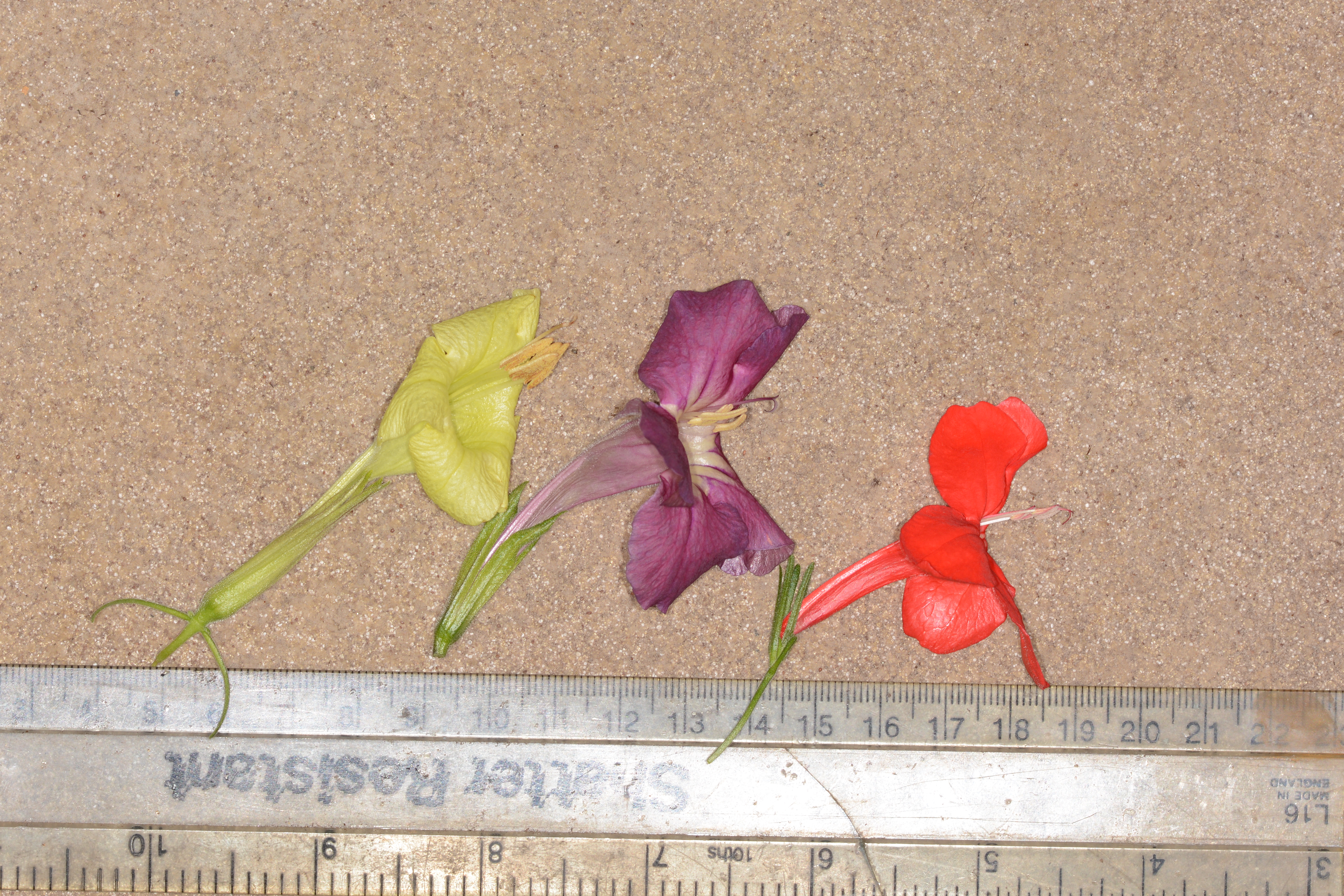
Hybrid Photos

PIs: Erin Tripp, Lucinda McDade

NSF Collaborative Research: Understanding Constraints on Floral Evolution: A Phylogenetic Approach to Comparative Anthocyanin Evolution in Ruellia (Acanthaceae)

Dates: March 2014 – March 2018

Small changes in a few genes involved in plant pigment synthesis, such as in blue, purple, or red anthocyanin pigments, can have dramatic effect on the evolution of lineages – both plants and their pollinators. New floral colors may attract different suites of pollinators, thus influencing lineage diversification and altering the evolutionary trajectories of life on Earth. This project combines new genomic technologies and traditional methods to investigate evolutionary trends in flower color evolution in a large lineage of tropical plants–Ruellia (Acanthaceae)–which has > 300 species in the Neotropics alone. Cutting edge genomic approaches will place the plant anthocyanin biochemical pathway in a comparative evolutionary context and facilitate understanding of how unorthodox floral color transitions, e.g., red-flowered ancestors giving rise to purple-flowered descendants, evolved. A near-complete phylogeny of New World Ruellia will be reconstructed using novel molecular markers (Ultra-Conserved Elements), which are being developed as part of this project. These markers will have substantial utility to related downstream research.

Flowers are among the most common means by which humanity connects to nature. Thus, floral biology has great potential to engage broad audiences in science. This research will shed light on the anthocyanin biochemical pathway, which contributes to numerous important plant functions (e.g., pollinator and fruit disperser attraction, UV sunscreen, herbivore defense), and have also been linked to human health benefits (e.g., anti-cancer, -viral, -inflammatory, -arteriosclerosis activity; treatments for hypertension, vision disorders). Anthocyanins are common constituents of human diets, being found in frequently consumed fruits and vegetables. This research project will add substantially to knowledge of the genetic basis of anthocyanin production and will thus have implications for human health research.

Prospective Postdocs: In 2014, Rancho Santa Ana Botanic Garden will be hiring a postdoc to coordinate and lead 5 extended fieldtrips througout the Neotropics. Contact Lucinda McDade (lucinda.mcdade@cgu.edu) with questions. In 2015, The University of Colorado will be hiring one postdoc to spearhead the floral transcriptomics aspects of this research. This postdoc should have extensive, prior training in managing and mining transcriptome data, in this case from a non-model organism and for genes (structural and regulatory) involved in the Anthocyanin Biosynthetic Pathway. Please feel free to contact erin.tripp@colorado.edu with further inquiries.

Oren Rabinowitz

orenrabinowitz

I was born in Israel, raised in New Jersey, and graduated with a B.A. in Ecology and Evolutionary Biology at The University of Colorado-Boulder in 2014. In the late fall of 2013, I joined the Tripp Lab to pursue a research question that Erin Tripp and I had discussed when I was a student in her Plant Systematics class. I wanted to find out what the powder found on aspen tree bark was made of. I asked Erin, who suggested the question was to her knowledge an unanswered one. I immediately signed up for independent study, and together we designed a study aimed at elucidating why aspen tree bark was powdery, and what the possible functions of this powder are.

We began our investigation with a literature review in November of 2013 followed immediately by fieldwork. Most people who have put their palms to an aspen tree are familiar with this curious powder in question. It tends to stick to your fingers and feels like a dusty chalk. Observations made by scientists who studied the aspen tree in the 1900’s recorded many helpful observations about the presence and color of the powder. Some non-scholarly sources claim that the powder is actually a wild yeast that can be used for homestyle fermentation, or as a natural sunblock. The most recently recorded observation was made by Univ. of Colorado Emeritus Professor and Botany Curator Dr. William Weber in his Colorado Flora: Eastern Slope, published in 2012. In that work, Dr. Weber speculated that the powder might be the developing thallus of a lichen.

Erin and I devised a working hypothesis that the white powder that characterizes aspen bark was actually aspen bark cells and that beta-carotene was the pigment responsible for the orange coloration of the powder. Beta-carotene is a carotenoid important to plant photosynthesis: not as an active contributor to the process but rather a molecule that helps transmit energy to chlorophyll while also playing a protective role for chlorophyll via its antioxidant properties. Starting in December of 2014, we collected samples from 11 aspen populations in Boulder County. Small squares of bark were cut, tagged, returned to the lab, then refrigerated. Once dry, thin cross-sections of samples were prepared via hand and then photographed under magnification for further study. Subsamples were then pulverized and extracts of bark pigment were made with acetone. These extracts were spotted onto Thin Layer Chromatography (TLC) plates to determine presence or absence of photosynthetic pigments and accessory pigments present in the bark powder.

Microscopy and cross-section analyses revealed that the bark layer of the aspen tree is divided into three layers (from inner to outer): the cork cambium, a layer of orange cells, and finally a layer of white cells. The cork cambium is immediately subtended by green, photosynthetic chlorenchyma, and our TLC trials confirmed that this tissue layer contains all photosynthetic pigments you would normally find in the leaves (e.g., beta-carotene, pheophytin, chlorophyll-a, chlorophyll-b, and xanthophyll). In contrast, the outer two layers (orange cambium and white bark) contained no photosynthetic compounds. As such, the orange pigmentation present in powdery aspen bark is not beta-carotene and remains unidentified. The orange layer is composed of heavily conglutinated cells that, as they age, become white and lose cohesion.

Our study demonstrated that aspen trees exhibit a unique method of bark cell shedding. The accumulated layer of bark cells on the surface of aspen trees do not stick together and do not form a solid mass of protective tissue. Rather, the aspen sheds mature bark cells in a powder so that sunlight can continue to penetrate the cork and cambium to reach the chlorenchyma. When powder is removed from aspen trees, the orange cambium is visible above the verdant chlorenchyma directly beneath. Younger cork cells tend to be orange in color whereas older cork cells are white and give aspens their ghostly appearance.

Many questions remain regarding the physiology of aspens and aspen bark. What is the orange pigment responsible for the orange hue? Is sunlight the primary factor that bleaches the orange bark cells? Does weathering and physical removal of white cork cells make aspen bark more prone to sun-scald? How do aspens prevent secondary infection without a thick bark layer? We think these questions can be answered by the next undergraduate to join the Tripp Lab!