Petalidium setosum

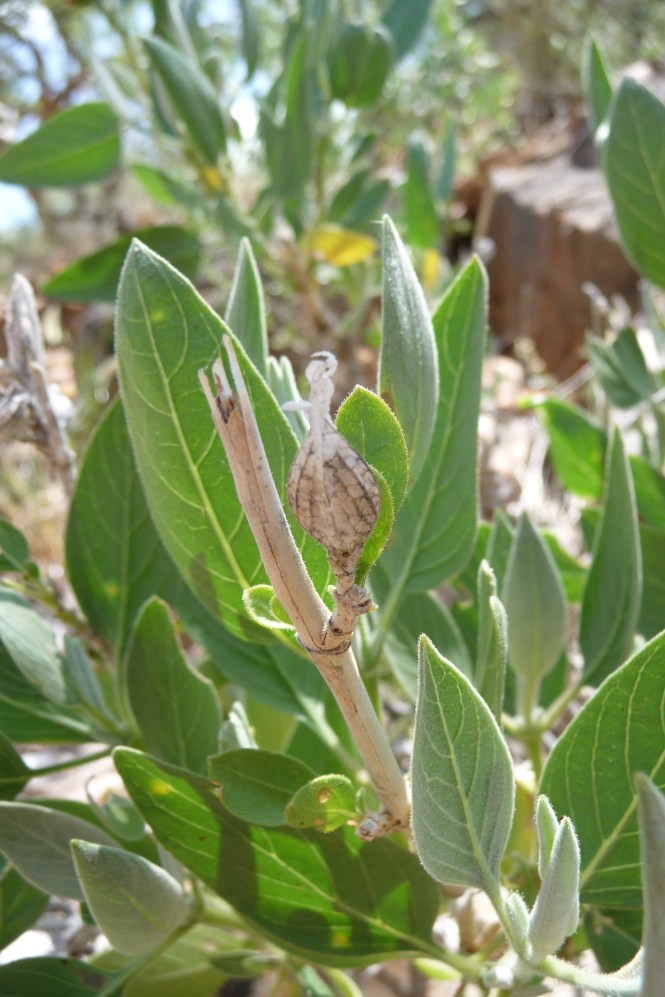
If you are a Latinist, you have already appreciated the specific epithet for what it means. The dense trichomes that cover the inflorescence bracts give this species its name.

Petalidium setosum is a highly distinctive, scandent shrub that is somewhat ‘special’ among Namibian Petalidium because of its large-ish geographical range… from north central Namibia to extreme southern portions of the country. But wherever it grows, you almost always find it in shallow depressions, indicating it is likely on the needier side of water availability. Its scabrous leaves and its lanceolate (not linear) inflorescence bracts (these densely covered by long, villous trichomes) make this species completely unmistakable.

That is, until you find a hybrid. That’s precisely what we think we found on our May 2014 outing (Essie Klaassen, Iain Darbyshire, Leevi Nanyeni, & Co.) in the Kaokoveld: a population of plants perfectly intermediate between Petalidium setosum and P. halimoides. It had the leaves of the former but lacked their scabrousness. It also had flowers that produced a musky odor, just like those of P. setosum. Yet, these plants had inflorescences of the latter—much denser and with linear bracts. Stay tuned for further study…. never a dull, unless it’s scabrous.

Wild collected, Namibia, Tripp & Dexter #887 (RSA-POM) [and numerous other times]; Photo by Erin Tripp

Petalidium rossmanianum

Holy smokes – what to do with this one? You look like, too much like, Petalidium variabile. But I want to believe you are distinguishable from that species for multiple reasons.

The identity crisis (which could be as much my problem as its) remains a mystery. We have encountered strange populations that seem to intergrade between ‘good’ P. rossmannianum and plants of the Petalidium variabile sort. We have encountered other populations where the differences seem so clear. Desperately awaiting molecular data.

Wish us luck. Kyle and I need it. Even Lucinda spent several puzzled moments by this ‘boot-if-ful’ species…

Wild collected [numerous times], Namibia, Tripp & Dexter #4053 (RSA); Photos by Erin Tripp

Petalidium rautanenii

A quick flash of something brilliant and summoning at 80 km / hr from the Land Cruiser. So alluring that even my mom noticed it (yep – fieldwork with the parents in Namibia – never a dull). We were gliding down a dirt highway not far from Waterberg when I first laid eyes on Petalidium rautanenii. 

Petalidium rautanenii cannot possibly confused with any other species in the genus, based on macromorphology alone. One of the very few taxa with gaudy, pure white flowers. I suspect my immediate love for it was far greater than its’ for me. Another unrequited…sigh.

This is my 23rd species (not including all the putative new species), and the most recent, that I have encountered in the field. It’s getting harder to find new ones without going to Angola, but, that being said, the world of discovery about each of those 23 is wide open. Community assembly, niche biology, adaptation, speciation, climate change tracking…. you name it.

Wild collected, Namibia, E. Tripp w/ L. Tripp & C. Tripp #4796 (COLO); Photos by Erin Tripp

Petalidium ramulosum

This slideshow requires JavaScript.

You there! WHAT do you make of this? So clearly related to the ‘dense heads’ clade (not that we have much understanding of the phylogeny of Petalidium…. yet), but with heads much more lax than those of its close relatives, which we presume to be: P. setosum, P. lanatum, P. halimoides, P. canescens, and perhaps P. angustitibum (among other Angolan delicacies).

Petalidium ramulosum is absolutely distinctive within the genus by its low, creeping habit (check out those adventitious roots…don’t be jealous!). Although one can find this species on a few ‘roadsides’ in Namibia (roadsides in quotes because most Namibian roadsides are nearly as pristine as the rest of the landscape), you’ll be lucky if you do. It rarely exceeds 10 cm in height and spends its days buried far underneath the dense grasses. You would seek shelter from the scorching Namibian sun, too…

Moral of story: don’t settle for being an underdog. Look up to this species, which hasn’t let its short stature or unemphatic, low-profile give it a complex…Oh no. She creeps proudly!

Like any good Petalidium, this species has a rather restricted / limited distribution, worldwide. I don’t know how Kyle and I were so lucky to have found it. Its inflorescences remind me most of those of Petalidium angustitibum (check out photos of that species on this website), and I’d not be surprised if the two were each others closest relatives. Lucky them.

Wild collected, Namibia, Tripp & Dexter #4120 (RSA); Photos by Erin Tripp.

Petalidium pilosi-bracteolata

YOU are a problem child! Locally abundant (indeed dominant) in the greater Erongo region. But with a complex identity (derived from P. variabile? or not?)….sometimes with awesome, fimbriate trichomes. But not always. If you had them, you would only wear them on special occasions, too.

Wild collected, Namibia, Tripp & Dexter #876 and #4096 (RSA-POM); Photos by Erin Tripp

Petalidium physaloides

Petalidium_physalioides

Everybody needs a compliment. For this plant, it is a stretch. Give me some flowers or at LEAST some fruits to work with.

We collected this as yet enigmatic plant in the depths of Van Zyl’s Pass… on the only day in my life that I have ever seen Kyle visibly nervous (yep, right before we decided that our Toyota could travel no further and, despite what all of the guidebooks say–that you cannot turn around in the middle of Van Zyl’s Pass once you initiate the traverse–Kyle and I used good judgement [for once] and spent the rest of the afternoon reconstructing the rocks that comprised the 4×4 track, by hand, and eventually made it out of the pass with success). This plant remains a huge mystery to us, but for now, we are calling it Petalidium physaloides. We aim to one day return to Van Zyl’s, more properly equipped, to figure this one out.

Wild collected, Namibia, Tripp & Dexter #844 (RSA-POM); Photo by Erin Tripp

Petalidium ohopohense

Oh, Ohopo, oh-no. We need another look at you. You’ve got some pretty pink flowers and even prettier yellow nectar guides, but that doesn’t mean that we fully know your name. World: meet Petalidium complexity. Its sort of like trying to count above 10 as a botanist: difficult. Why not just say “infinity”?

Infinitely difficult to understand until (a) we get some serious molecular data or (b) the plants start speaking English (AND answering our questions).

Wild collected, Namibia, Tripp & Dexter #849 (RSA-POM); Photos by Erin Tripp

Petalidium luteo-album

This is a DAMN fine species and you would be hard pressed to ever find anything so beautiful in the Logee’s catalogue. Petalidium luteo-album is clearly the sister species to P. giessii. It (P. luteo-album) also occurs with the latter (P. giessii) in the Grootberg Mountains (= geological capital of the universe), but also has a much wider range, extending into the northern Kaokoveld. It is also the only species of Petalidium that produces truly succulent leaves.

In May 2014, we found our first ever mixed population of the two species (P. luteo-album and P. giessii). How on Earth do these species maintain reproductive isolation? They were flowering concurrently, and literally doing so side-by-side (see photo of the two, laid against a herbarium blotter). In all fairness, it did seem that the former was going out of flower just as the latter was coming into flower, which is precisely what one would expect under reproductive character displacement scenarios. In any case, the population is georeferenced, and desperately in need of further field (and genetic) study.

Photo with the ruler so clearly shows the genus synapomorphy: paired bracts subtending each flower. That photo also very nicely shows the ribbed (‘herringbone’) patterning on the lower portion of the corolla throat. It doesn’t matter which way you twist the flower around, or whether you look at it while standing on your head. Petalidium luteo-album will forever enchant you. Watch out for the spell.

Wild collected, Namibia, Tripp & Dexter #830 (RSA-POM); Photo by Erin Tripp

Petalidium lucens

Dear Petalidium lucens,

Way back when I was a graduate student at DUKE, I happened upon a loan of a herbarium specimen of you. I remember the day: I was sitting at the far end of the herbarium, with Dr. Wilbur looking over my shoulder to monitor my mischief. When I laid eyes on your bracts, it was love at first sight. (That, and the dense white tomentum of Petalidium englerianum….). At the time, I never knew that you and I would eventually cross paths. Well, 10 years later, we have. I am so glad that you waited for me…..

I have always wanted to tell you that I find you to be among the most brilliant species of what Kyle and I call “the Southern Clade” (Did you know you were part of a clade? Do you care?). Please tell me: what is the developmental basis for those beautiful, papery bracts that are interwoven by thick, red veins? What is the adaptive value, if any? And why is it that you inhabit such a narrow corner of Namibia, refusing to grow anywhere else on Earth?

Locally abundant, globally beautiful, you always make me smile whether in the cellulose, in the herbarium, from a photograph, or via a memory….

With fondness,

A botanical admirer

PS: Your friend, Petalidium linifolium, told me to tell you to get some skinnier leaves.

Wild collected, Namibia, Tripp et al. #2065 (RSA-POM); Photo by Erin Tripp

Petalidium linifolium

Woot woot!

Here we go with the “southern clade”… species of Petalidium that are restricted to southern Namibia (and in some cases, ever so slightly beyond). They have the loveliest of calyces – papery with glowing thick red veins against an otherwise nearly translucent background. Petalidium linifolium is closely related to P. lucens and P. parvifolia. Kyle and I have some further work to do before we make any final calls on this clade, but for now, sit back and enjoy the glory. Maybe with a nice glass of cool, South African chardonnay (I recommend something from Stellenbosch…perhaps a Jordan….served at a perfect 49 degrees F). This species wants you to embrace it properly.

Wild collected, Namibia, Tripp et al. #2031 (RSA-POM); Photo by Erin Tripp